.png)
.png)
Introduction: The Shift to AI-First Systems
Artificial intelligence has become a standard part of modern business platforms, and CRM systems are no exception. In fact, 83% of companies are already using AI features or smarter automation and personalized experiences.
Sales teams want quick summaries of accounts and opportunities. Managers look for insights into deal progress and potential risks in the pipeline. Forecasts are expected to include predictive signals to help teams plan with confidence. Finance teams want real-time visibility into revenue trends and pipeline health rather than waiting for static reports.
As capabilities expand, a common question arises: if agents like Agentforce can retrieve data from external systems through configured APIs, are structured Salesforce integrations still necessary?
In practice, this assumption overlooks how enterprise systems operate. AI agents can access data through APIs, but they do not replace systems of record and depend entirely on data stored in Salesforce and other connected systems. APIs provide access, but they do not enforce structure, maintain relationships, or ensure consistency across records.
Without structured integration, AI insights are limited. Salesforce remains the operational CRM, and AI cannot redesign the data model or enforce consistency across systems. Structured integration is essential to ensure reliable, actionable AI insights.
What an AI-First Stack Really Means in Practice
An AI-first stack changes how users interact with systems, not how Salesforce is built internally. The visible layer becomes conversational interfaces, AI summaries, predictive models, and recommendations. These tools make it easier to access insights, but below the surface, the same objects, fields, record types, validation rules, and relationships still define how Salesforce data is organized.
AI does not:
- Redesign object relationships,
- Reconcile conflicting ownership rules,
- Standardize lifecycle stages across external systems.
When required fields are inconsistently filled, object relationships are loosely defined, or revenue data is incomplete, AI works on weak CRM data architecture. Its outputs directly reflect the quality of the Salesforce data model. Inaccurate or incomplete data will result in summaries, recommendations, or predictions that are less reliable.
This means the more structured and well-maintained your Salesforce environment is, the more effective AI will be. Clean data, properly defined relationships, and consistent record management make AI insights more useful. AI does not reduce the need for careful CRM governance. In fact, it increases it. Companies using an AI-first approach must keep data entry, validation, and processes disciplined to make sure AI tools produce trustworthy and actionable outputs.

Seamless integration is critical for AI success. Without it, even advanced tools can create complexity rather than value. The 2026 MuleSoft Connectivity Benchmark Report highlights this, showing how nearly all respondents agree that AI agents depend on strong integrations, while many warn that poor integration can introduce new challenges.
The Limits of AI Without Proper Integrations
Even with a strong internal data model, Salesforce does not operate in isolation. Critical business data often originates in other systems. While AI systems can retrieve data from other platforms through configured APIs, that alone does not make the data usable within Salesforce. For AI to reason across records, information must be brought into Salesforce through structured integrations.
This is not a limitation of AI. It is an integration boundary. AI can only analyze the records available within Salesforce. If financial transactions, usage metrics, contract updates, or operational milestones are not synchronized into the CRM, the analytical layer remains incomplete.
In practice, organizations face real challenges with integrations, according to the Connectivity Benchmark Report. About 25% report difficulties ensuring data quality for AI or autonomous agents, 16% struggle with governance across applications, and 14% find integrating systems without duplicating data (“zero-copy” integration) particularly difficult. These numbers underscore why structured, well-governed Salesforce integrations are essential.
When integrations are weak, the operational impact becomes measurable:
- If payment status is not synchronized from ERP, AI may forecast revenue on unpaid deals;
- If product usage is not integrated, AI cannot distinguish active customers from dormant accounts;
- If ownership changes are not reflected in both systems, pipeline predictions become inaccurate;
- If lifecycle definitions differ across systems, customer health signals fragment.
Access to APIs alone does not guarantee operational data integrity. AI in Salesforce depends on structured, reliable integrations that bring external data into the CRM, where it can be connected, validated, and analyzed. Without them, even the most advanced AI tools operate on incomplete information, and insights can be misleading.
Where AI and Integrations Work Together
Integrations define how external data enters Salesforce in a consistent and usable way. AI defines how that data is analyzed. When systems are connected through consistent identifiers, timestamps, ownership rules, and source-of-truth definitions, AI can reason across entire business processes, not just isolated fields.
For example, it can:
- Correlate usage trends with renewal probability,
- Connect payment behavior to opportunity health,
- Surface cross-system patterns across marketing, finance, and operations.
Structured integrations ensure external data becomes part of Salesforce in a way AI can interpret. This means data is mapped to the correct objects and fields, kept up to date, and organized so relationships and ownership are clear. AI then works on this reliable foundation to produce meaningful insights and predictions.
To illustrate this, it helps to look at the challenges companies face with financial data and the solutions available to address them. Breadwinner provides a clear example of structured QuickBooks Salesforce integrations, that replicate financial data directly into Salesforce objects.
Use Case: Automating QuickBooks Invoice Status
Imagine a team tracking invoice status manually. Without Salesforce accounting integrations, every update in QuickBooks must be entered by hand into Salesforce, creating delays, errors, and extra work for finance and sales teams.
With Breadwinner for QuickBooks, invoice status and other financial data are automatically replicated into Salesforce, keeping records synchronized and accurate.
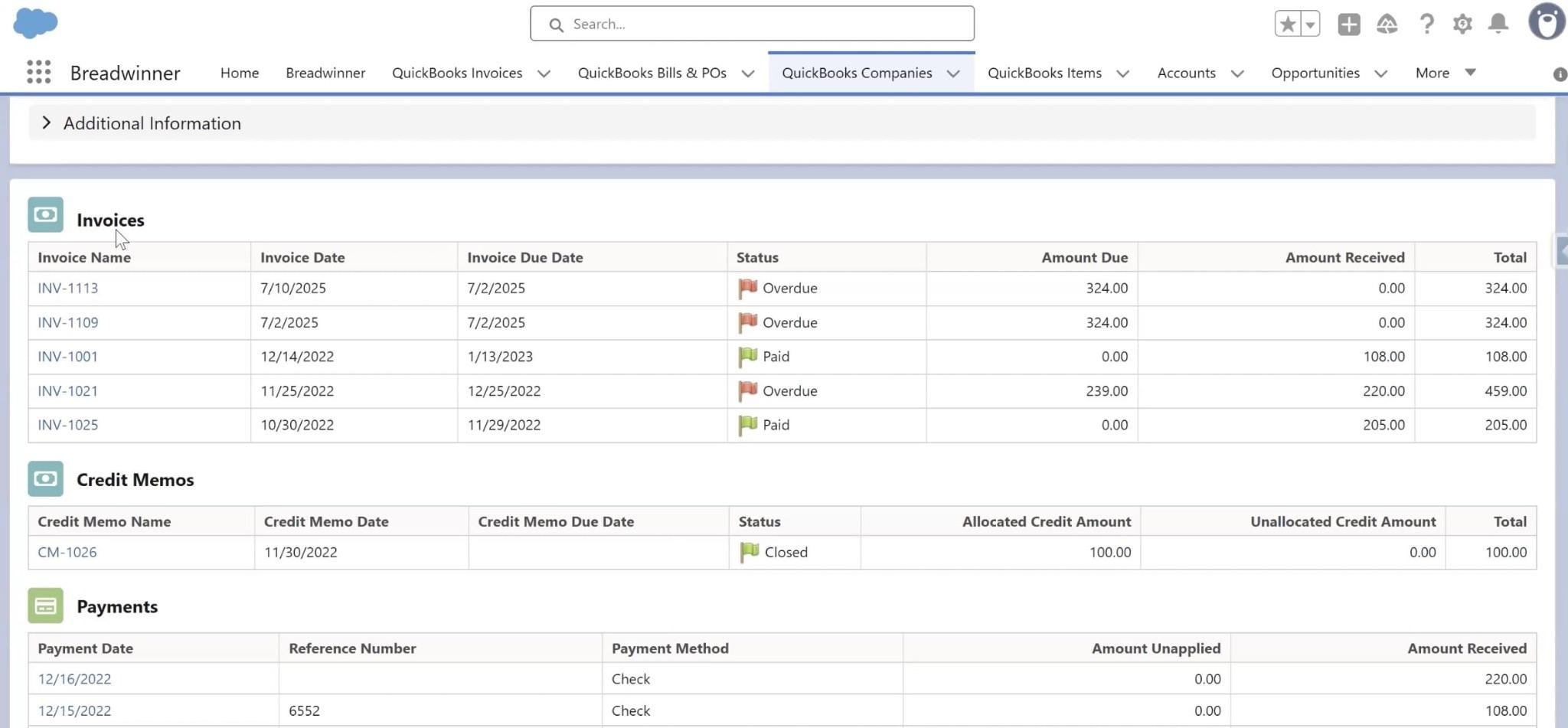
Breadwinner for QuickBooks Agentforce then adds a conversational layer, allowing users to interact directly with that data.
For example, a user can ask Agentforce, “What is the status of invoice #12345 in QuickBooks?” and receive an immediate, accurate answer pulled from Salesforce. This eliminates manual lookups, reduces errors, and accelerates decision-making.
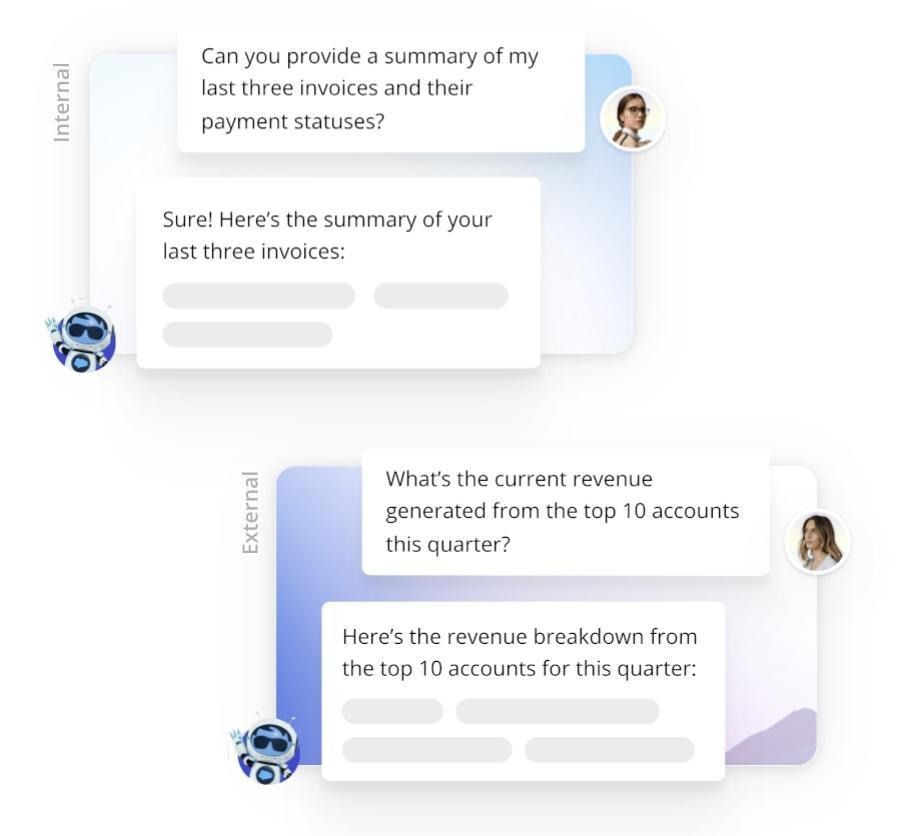
By replicating QuickBooks data into Salesforce, Breadwinner accelerates Agentforce adoption and enables teams to unlock AI-powered insights faster. Salesforce serves as the trusted source of data, while Agentforce provides the interface for asking questions, monitoring financial health, and even performing operational actions. Together, this integration shows how structured data and AI-driven interactions can work seamlessly to improve efficiency and visibility across the business.
When Lightweight Connections Are Not Enough
Many organizations begin with tactical integration solutions when connecting Salesforce to other systems. This might be a one direction data push, a small custom script, or a lightweight connector used mainly for reporting.
At first, this approach solves a specific problem. A team may only need basic financial visibility in Salesforce or a limited set of external records for reporting. For a narrow use case, a simple connection can be enough.
Over time, these approaches begin to create operational risk. As systems evolve and new processes depend on the data, small integrations become difficult to maintain and govern.
Typical issues start to appear:
- Mapping logic is poorly documented. For example, a field mapping created in a script may not be recorded anywhere, making it difficult to understand how financial data reaches Salesforce reports.
- Schema changes break workflows or reports. When a field is renamed or a new object is introduced in an external system, integrations can stop updating records correctly.
- Data conflicts between systems remain unresolved. A payment marked as completed in the finance system may still appear as unpaid in Salesforce.
- Monitoring and reconciliation are limited. Failures in scheduled scripts or connectors may go unnoticed until users report missing or outdated records.
- Reporting discrepancies appears only after executive decisions are made. A forecast may include revenue from deals that were already cancelled or unpaid in the finance system.
As revenue operations mature and compliance requirements increase, Salesforce ERP integrations, for example, can no longer remain simple point solutions. They become part of the core CRM infrastructure that supports finance, sales operations, and executive reporting.
At this stage, Salesforce CRM integrations require stronger governance and long-term stability. This typically includes:
- Clear source of truth rules that define which system owns specific data,
- Bidirectional synchronization where updates must remain consistent across platforms,
- Monitoring and reconciliation processes to detect and resolve integration failures,
- Flexibility to adapt when objects, fields, or schemas change,
- Maintainable CRM integration architecture that can support the system over time.
Solutions such as Breadwinner for Salesforce QuickBooks integration are designed with this type of structured integration in mind, helping maintain consistent financial data between Salesforce and accounting systems.
In an AI-driven CRM environment, the quality of integrations becomes even more visible. Weak integrations introduce gaps and inconsistencies in the data. Strong integrations provide the reliable foundation that AI analysis depends on.
How Salesforce Integrations Evolve in an AI-First Environment
In an AI-first CRM environment, integrations are no longer simple connectors between systems. They become part of the operational architecture that supports analytics, automation, and decision making inside Salesforce.
When AI models analyze CRM data, they assume that the records reflect real business activity. If integrations introduce delays, inconsistencies, or missing history, the analytical layer inherits those gaps. This issue isn’t theoretical, according to Salesforce research, about 81% of IT leaders agree that data silos hinder digital transformation and make it harder to deploy AI effectively, underscoring the importance of strong integration and unified data architecture. For this reason, modern Salesforce integrations must operate with the same level of discipline as the CRM data model itself.
A stable Salesforce CRM architecture typically includes:
- Consistent external identifiers. Ensure records from different systems can be reliably matched.
- Accurate timestamps & historical data. Preserve the sequence of business events for accurate analytics.
- Validation rules & lifecycle governance. Respect Salesforce rules when records are created or updated.
- Bidirectional synchronization. Keep both systems aligned when updates occur.
- Exception monitoring. Detect integration issues before analytics or forecasting are affected.
- Schema adaptability. Handle Salesforce object or schema changes without breaking dependencies.
AI systems analyze patterns and probabilities based on the data available to them. Integration engines, by contrast, operate through precise rules that control how records move and update across systems. Both layers serve different roles but depend on each other.
Organizations that treat Salesforce integrations as durable infrastructure, rather than temporary connectivity, create the stable environment required for long-term AI adoption.
The Role of the Salesforce Admin in an AI-Driven CRM
In an AI-driven Salesforce environment, the role of the admin expands beyond configuration and daily system management. The admin becomes responsible for maintaining the data architecture that both business processes and AI systems depend on.
Governing the Internal CRM Structure
The first responsibility is governing the internal CRM structure. This includes how data is modeled and how records relate to each other across the platform.
Key areas include:
- Object design and field structure,
- Clear relationships between records,
- Validation rules that protect data quality,
- Lifecycle management for leads, opportunities, and customers,
- Defined ownership and data responsibility.
Overseeing How External Systems Connect to Salesforce
The second responsibility involves overseeing how external systems connect to Salesforce. Integrations must align with the CRM data model, follow defined source of truth rules, and preserve relationships between records as data moves across platforms.
Financial systems, product platforms, and support tools introduce information that must remain consistent once it enters Salesforce. AI operates on top of these two layers. It analyzes the data stored in Salesforce and the information synchronized from connected systems.
When CRM architecture or integration governance is weak, those weaknesses appear directly in AI outputs. Forecasts, recommendations, and insights reflect the quality and consistency of the underlying data.
Effective AI-driven CRM environments therefore depend on disciplined Salesforce administration and a well-governed integration strategy.
Conclusion: Salesforce Integrations Remain Foundational in AI CRM Architecture
AI transforms how users interact with CRM data. It introduces predictive insights, conversational interfaces, and advanced analytics. However, it does not replace structured Salesforce integrations that connect systems of record.
Reliable business decisions continue to depend on governed, traceable records inside Salesforce. Structured integrations provide the controlled pathways that maintain data integrity across finance, marketing, operations, and support platforms. Accounting software integration with Salesforce provides a clear example of how structured connections form the operational layer beneath AI insights. Tools like Breadwinner, which synchronize financial data into Salesforce, illustrate this in practice.
While AI layers evolve rapidly, core integrations often remain in place for years. In an AI-first CRM architecture, integrations do not disappear, they become even more critical. Intelligent outputs depend entirely on consistent, synchronized data beneath them.
Organizations that invest in durable, bidirectional Salesforce integration infrastructure can layer AI capabilities with confidence, knowing their CRM data foundation remains stable as analytical tools advance.
AI is the insight layer. Salesforce integration is the operational layer. Both are required for reliable, actionable CRM intelligence.
.png)


